
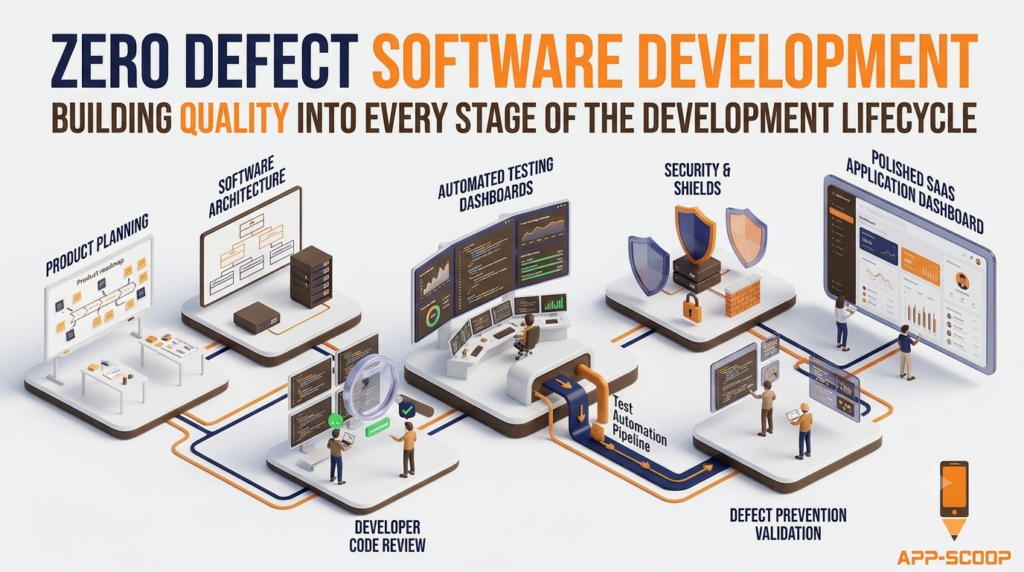
Zero Defect Software Development for SaaS
Developing a SaaS application involves much more than writing code and making features work as expected. A software product must handle different user activities, manage business information, communicate with external services, and remain dependable as its customer base and functionality evolve. Even a relatively small defect can affect an important workflow, interrupt an operation, or create problems that are difficult to identify later.
This is why software quality should be considered throughout the development lifecycle rather than treated as a final testing activity. Zero defect software development offers a useful philosophy for achieving this goal. It encourages development teams to prevent defects wherever possible, identify weaknesses early, and establish processes that reduce the likelihood of recurring problems.
For SaaS businesses, this approach is particularly relevant because applications are continuously updated and accessed by multiple users. Building reliable software requires consistent engineering practices, thoughtful planning, effective testing, and attention to what happens after deployment.
Understand Zero Defect Software Development
Zero defect software development is an approach that emphasizes preventing errors instead of relying entirely on finding and fixing them after development.
The idea does not mean that every software release can be guaranteed to contain absolutely no bugs. Modern applications involve multiple technologies, dependencies, integrations, and operating conditions. Completely eliminating every possible defect is not a realistic promise.
Instead, zero defect thinking encourages teams to establish clear quality expectations and make defect prevention part of everyday engineering work.
For example, consider a SaaS application that allows businesses to manage customer accounts. A basic testing process might verify whether users can create and update accounts.
A stronger quality-focused process would also examine permission boundaries, duplicate records, invalid information, concurrent updates, and unexpected failures. The difference is that quality is evaluated beyond whether a feature works under ideal conditions.
Begin with Clear and Testable Requirements
Some software defects originate before development even begins. When project requirements are incomplete, ambiguous, or inconsistent, developers may implement functionality based on assumptions rather than agreed expectations.
This can lead to rework, unexpected application behaviour, and disagreements about whether a feature has been completed correctly. A better approach begins with clear requirements.
Before development starts, teams should identify:
- The primary purpose of each feature.
- The intended users and their responsibilities.
- Expected inputs and outputs.
- Business rules and validation requirements.
- Access permissions and restrictions.
- Expected behaviour when something goes wrong.
- Dependencies on external services or systems.
Acceptance criteria are particularly useful because they describe how a feature should behave under defined conditions.
For instance, a subscription management feature should specify what happens when a payment succeeds, fails, expires, or requires additional verification. Defining these scenarios early gives developers and testers a shared understanding of the expected outcome.
Clear requirements do not eliminate every misunderstanding, but they provide a much stronger foundation for implementation and verification.
Design the Architecture to Reduce Avoidable Complexity
Software architecture has a direct influence on how easily an application can be developed, tested, maintained, and improved.
When an application grows without a clear structure, developers may find it increasingly difficult to understand how individual components interact. Changes in one area can also create unexpected problems elsewhere.
For SaaS products, architecture should reflect the application’s actual business and technical requirements.
Important considerations include:
Separation of responsibilities: Application components should have clearly defined responsibilities. This makes individual features easier to understand and maintain.
Database consistency: Appropriate relationships, constraints, and validation rules help protect the integrity of application data.
API design: Consistent API contracts make communication between frontend applications, backend services, and external systems more predictable.
Multi-tenant data isolation: Applications serving multiple organizations must ensure that one customer’s information is not improperly accessible to another customer.
Error management: Components should handle expected failures in a controlled and understandable manner.
There is no universal architecture that works for every SaaS product. The objective is to choose an approach that supports current requirements without creating unnecessary technical complexity.
Establish Coding Standards and Meaningful Code Reviews
Code quality is not determined only by whether an application produces the expected output. The structure, readability, and maintainability of the code also matter.
When multiple developers work on the same product, inconsistent coding practices can make collaboration difficult. Unclear naming, duplicated logic, complicated functions, and undocumented assumptions can increase the possibility of mistakes.
Establishing coding standards helps create consistency across the codebase.
Useful practices include:
- Following agreed naming and formatting conventions.
- Avoiding unnecessary duplication.
- Keeping functions and components focused.
- Managing dependencies carefully.
- Documenting important technical decisions.
- Reviewing changes before merging them into shared branches.
Code reviews provide another opportunity to identify weaknesses before they become part of the main application.
A useful review should consider more than formatting. Reviewers should examine business logic, error handling, security implications, test coverage, and the potential effect of a change on existing functionality.
The objective is not to make every developer work in exactly the same way. It is to create a shared engineering standard that supports maintainability and reduces avoidable errors.
Make Testing Part of Every Development Stage
Testing should not be postponed until the application is almost ready for launch.
A feature may work correctly in isolation but fail when connected to a database, another service, or an existing application workflow. Testing at different levels helps uncover these issues.
Several testing approaches contribute to a stronger quality process.
Unit testing: Individual functions and components are tested to verify their expected behaviour.
Integration testing: Connected components are tested together to identify communication and data-handling problems.
End-to-end testing: Complete user journeys are evaluated, such as account registration, login, subscription management, and other important workflows.
Regression testing: Previously working functionality is checked after changes to help identify newly introduced defects.
Performance testing: Application behaviour is evaluated under defined workload conditions.
Security testing: Potential weaknesses involving authentication, authorization, input validation, and data handling are examined.
Not every feature requires identical testing effort. Teams should prioritize tests according to the importance of the functionality and the potential consequences of failure.
A payment workflow, for example, generally deserves more attention than a minor visual adjustment because incorrect payment handling can directly affect customers and business operations.
Use Automation to Improve Testing Consistency
Manual testing remains valuable, particularly when evaluating user experience, unexpected behaviour, and workflows that require human judgment.
However, repeatedly checking the same functionality manually can become time-consuming as an application grows. Automated testing helps teams execute repeatable checks consistently.
A development team might configure automated tests to run whenever code changes are submitted. These tests can check important application functionality before changes are approved for integration.
Continuous integration pipelines can also include:
- Code quality checks.
- Static code analysis.
- Automated unit tests.
- Dependency vulnerability checks.
- Build verification.
- Selected integration tests.
Automation should support engineering judgment rather than replace it. Automated tests are only useful when they cover meaningful scenarios and are maintained as the application changes.
A large collection of unreliable tests can create confusion rather than improve quality. Teams should focus on tests that provide useful feedback and help prevent important regressions.
Address Security Defects During Development
Security is an important part of software quality, especially for SaaS products that process customer information and support business operations.
Security weaknesses can result from seemingly small development decisions, such as trusting user input, exposing sensitive configuration values, or implementing permissions inconsistently.
A quality-focused development process should consider security from the beginning.
Important practices include:
- Implementing appropriate authentication mechanisms.
- Enforcing authorization on the server side.
- Validating and sanitizing user input.
- Protecting sensitive credentials and configuration values.
- Reviewing third-party dependencies.
- Using secure communication protocols.
- Maintaining appropriate access controls.
- Reviewing application logs for sensitive information.
For multi-tenant SaaS platforms, developers should pay particular attention to tenant-level access restrictions. Every relevant data access operation should enforce the correct authorization boundaries.
Security reviews should also continue after deployment because new features, dependencies, and integrations can introduce additional risks.
Investigate Root Causes Instead of Repeatedly Fixing Symptoms
Finding and correcting a bug is important, but the work should not necessarily end when the immediate issue disappears.
Some defects occur because of deeper problems in requirements, architecture, testing, communication, or development processes.
Consider a situation where users repeatedly encounter incorrect information after updating their account details. Fixing the visible interface may not address the underlying issue if the actual cause is inconsistent data handling between application components.
Root cause analysis helps teams understand why a problem occurred.
A practical investigation can involve:
- Reproducing the issue under controlled conditions.
- Examining relevant logs and application behaviour.
- Identifying the component or process responsible.
- Determining why existing checks did not detect the issue.
- Implementing an appropriate correction.
- Adding regression tests where useful.
- Reviewing whether similar weaknesses exist elsewhere.
This approach helps turn individual defects into opportunities to improve the overall development process.
Blameless reviews are also valuable. The purpose should be to understand and improve the system of work, not simply identify an individual to hold responsible.
Maintain Quality After Deployment
Software quality does not stop when an application goes live. Real users interact with products in different ways, and production environments introduce conditions that may not have been fully represented during development.
Monitoring helps teams understand how applications behave after deployment. Useful operational practices include application logging, error monitoring, availability checks, performance monitoring, and regular backup verification.
Release management also plays an important role. Rather than exposing every update to all users immediately, teams may use controlled deployment strategies such as staged rollouts or canary releases.
These approaches allow changes to be observed on a limited scale before broader distribution. A rollback or recovery plan is also important when an update causes unexpected problems.
Customer feedback, support requests, incident reports, and monitoring information should inform future development priorities.
This creates a continuous improvement process in which operational experience contributes to better engineering decisions.
Measure Software Quality Through Meaningful Indicators
A zero defect philosophy becomes more practical when teams can evaluate whether their development processes are improving.
However, measuring quality using only the number of reported bugs can create a misleading picture. A product with fewer reported defects is not automatically more reliable if testing coverage is weak or customers have difficulty reporting problems.
Teams can consider several complementary indicators:
Defect escape rate: The number or proportion of defects identified after release compared with those detected earlier, using a clearly defined measurement approach.
Defect recurrence: Whether previously corrected problems appear again.
Regression test results: Whether existing functionality continues to pass relevant tests after changes.
Incident trends: The frequency, severity, and recurring causes of production issues.
Mean time to recovery: How long it takes to restore service following an operational incident.
Change failure rate: The proportion of changes that result in service degradation or require corrective action.
These measurements should be interpreted in context. They are tools for identifying improvement opportunities, not proof that a software product is completely defect-free.
Make Quality a Shared Engineering Responsibility
One of the most important aspects of reliable software development is ensuring that quality is not treated as the responsibility of a single testing team.
Developers, product managers, designers, testers, and operational teams all influence the final product.
Product managers help clarify requirements. Designers contribute to understandable user experiences. Developers implement and review functionality. Quality engineers evaluate expected and unexpected behaviour. Operations teams monitor application health and support recovery.
When these responsibilities are coordinated, quality becomes part of the entire development process. For SaaS businesses, this collaboration is particularly important because product requirements continue to evolve after launch.
A shared commitment to quality helps teams make more informed trade-offs between development speed, technical complexity, and long-term maintainability.
Conclusion
Zero defect software development is best understood as a continuous commitment to preventing defects, strengthening engineering practices, and improving the reliability of software products.
For SaaS applications, this means establishing clear requirements, designing maintainable architecture, following consistent coding standards, testing important workflows, addressing security risks, and monitoring applications after deployment.
No testing strategy or development methodology can guarantee that every defect will be eliminated. However, teams can reduce avoidable errors by identifying risks early and treating quality as an essential part of every development decision.
Ultimately, reliable SaaS products are not created through a final round of testing alone. They emerge from disciplined planning, thoughtful engineering, collaboration, and continuous improvement throughout the software lifecycle.
About The Author